UPS’s 2027 increase averages a net 5.9 percent on its Ground, Air and International daily rates. That’s the number FedEx announced in September (FedEx’s 2027 increase), and the third year running both carriers have landed on it.
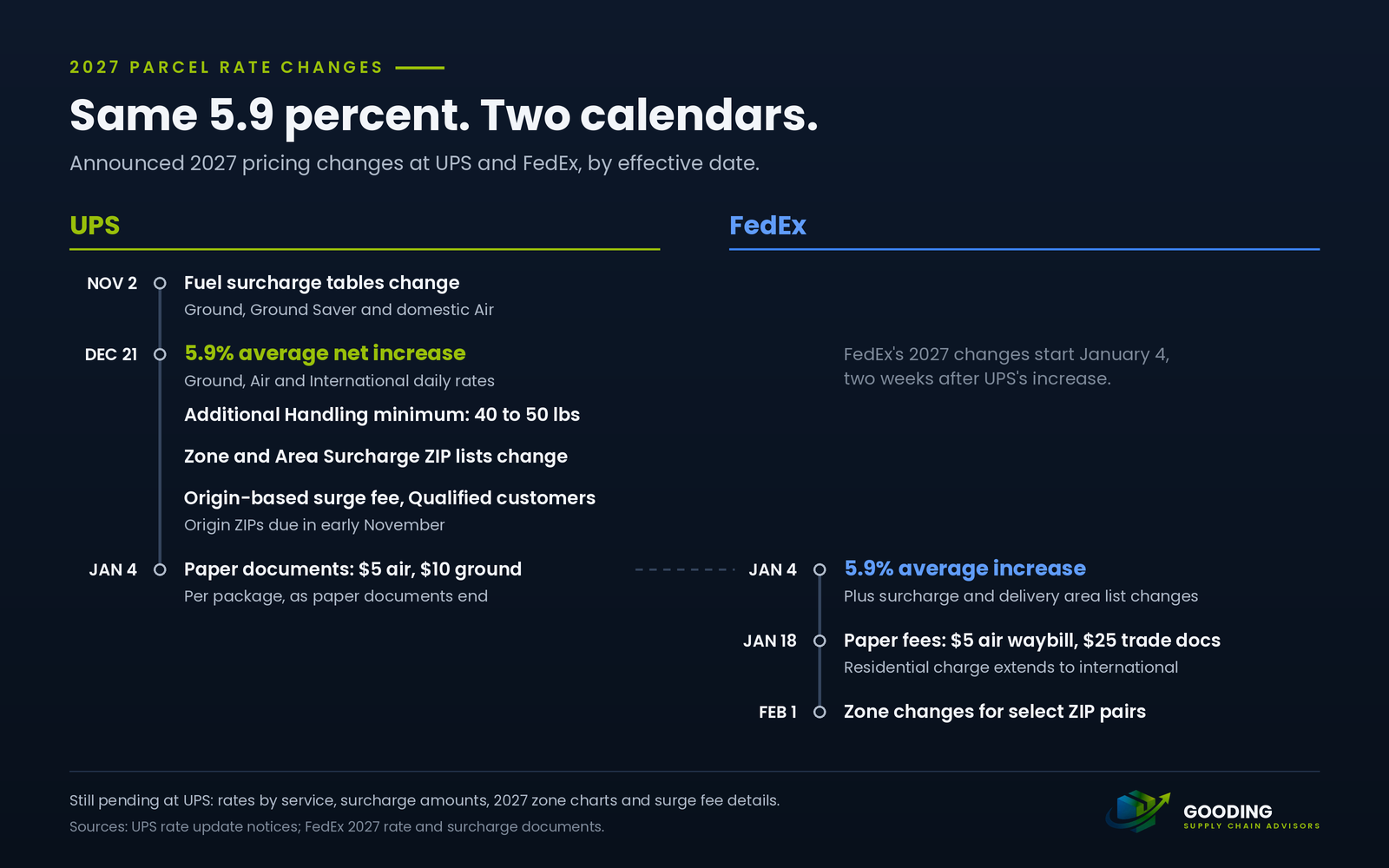
UPS’s takes effect December 21, 2026. FedEx’s takes effect January 4. Same number, two weeks sooner, and those two weeks change the part of the increase that lives in your agreement.
What UPS has published
November 2, 2026. Fuel surcharge tables change for U.S. Ground, Ground Saver and domestic Air. UPS lists this outside the increase, on the same notice page.
December 21, 2026. Daily rates for Ground, Air and International rise an average net 5.9 percent, and the published Small Business Rates rise too. The ZIP lists for Area Surcharges and for zones change. The minimum billable weight for Additional Handling packages goes from 40 lbs to 50. And Ground and Ground Saver shipments from certain origin ZIP codes pick up an additional per-package surge fee for what UPS calls Qualified customers.
January 4, 2027. Paper shipping documents are discontinued. Shipments tendered on a paper Air Shipping Document carry a $5.00 per package surcharge. 3 Day Select and Ground shipments tendered on a paper Ground Shipping Document carry $10.00.
UPS says more detailed rate previews will follow. Rates by service, weight and zone, the surcharge amounts and the surge fee details aren’t out yet. I’ll add them here as a dated update when they are.
The First Increase: 5.9 percent is an average
FedEx’s tables showed how wide an average can run. Ground packages from 1 to 5 lbs averaged 6.5 percent, and Express Saver averaged 3.1.
The same cell-by-cell read on UPS waits for its 2027 tables. UPS’s notice already makes the point in its own words: the impact “will vary according to your shipping characteristics and the terms of your UPS agreement.”
The Second Increase: changes with no percentage
Most of what UPS has published so far carries no percentage. It changes what gets billed.
The 50 lb floor. An Additional Handling package that weighs 30 lbs bills at 40 lbs under the 2026 rules and at 50 from December 21. At 45 lbs it moves to 50, and at 50 or more nothing changes. For the lightest of these packages, that’s 25 percent more billable weight before the 5.9 percent applies.
The floor only bites when a package’s actual and dimensional weight both sit under 50 lbs. A 20 lb carton measuring 50 by 10 by 8 inches is one: its length triggers the charge, and at UPS’s daily-rate divisor of 139 its dimensional weight is 29 lbs. Long, narrow cartons and items that trigger the charge through their packaging are where to look.
Zones. The list of ZIP codes aligned to certain zones changes December 21. My FedEx piece compared the two carriers’ Ground zone charts on 15,334 origin and destination pairs and put a labeled hypothesis on FedEx’s February 1 change. Both sides of that comparison move between December 21 and February 1. When UPS posts its 2027 charts, I’ll measure what moved, then rerun the comparison.
Area Surcharges. The ZIP list changes December 21. A ZIP that joins the list or moves to a higher tier pays more with no change in the rate.
The surge fee. It applies by origin ZIP, for Qualified customers, with the ZIP list and details due in early November. Until UPS publishes them, the exposure can’t be sized. What’s already clear is that, for those customers, where you ship from becomes a price variable on UPS Ground.
Paper. UPS’s paper surcharges start January 4, and UPS reserves the right to refuse those shipments or return them at the shipper’s expense. FedEx’s paper fees start January 18: $5 on a paper air waybill and $25 on paper trade documents. Both carriers price paper within the same month.
The Third Increase: your agreement
The first two increases live in UPS’s documents. The third lives in yours.
An agreement that takes effect before December 21 starts on the 2026 tariff and rolls onto the 2027 tariff on December 21, two weeks before FedEx’s turns over. If you’re repricing with UPS in the fall, the window I described in Reprice in the Fall. Move in the Spring. closes two weeks sooner on that side.
The concession check carries over. A fixed-dollar concession loses ground at each surcharge increase, and a percentage keeps pace. When UPS’s surcharge amounts post, run your concessions against them, and check how your agreement treats Additional Handling.
What you can still control
Count your Additional Handling packages that bill under 50 lbs. That’s your exposure to the floor, and you can measure it from your own invoices.
Get off paper before January 4 at UPS and January 18 at FedEx.
If you’re signing with UPS before December 21, know what the December 21 changes do to your costs before you sign.
Check your origins against the surge fee ZIPs when UPS publishes them in early November.
Check your ZIPs against the 2027 Area Surcharge lists, and your lanes against the 2027 zone charts, when they post.
The bottom line
Both carriers held 5.9 percent for 2027. UPS gets there two weeks sooner, and most of what it has published so far carries no percentage.
Takeaway: The same increase on an earlier date is an earlier deadline.
Which date is your 2027 plan built on: December 21 or January 4?