FedEx announced its 2027 increase on September 18: 5.9 percent, effective January 4. It announced 5.9 percent for 2026, and for 2025. UPS announced the same number for both of those years.
It is also FedEx’s first increase since the Freight spin-off, which makes it the first test of an argument I made when the spin-off closed: that a parcel-only FedEx would grow yield in three places, and the published increase is only the one with a percentage on it.
The number stayed put. Here is what moved underneath it.
What FedEx announced
- January 4. List rates rise an average of 5.9 percent. Surcharges and fees change, and new delivery area and pickup area ZIP lists take effect.
- January 18. A $25 fee on shipments with paper trade documents and a $5 fee on paper air waybills. The residential delivery charge extends to qualifying international shipments.
- February 1. New zone assignments for select U.S. domestic origin and destination ZIP pairs.
The announcement includes no change to dimensional weight rules or the fuel surcharge table. The FedEx figures below come from its published 2027 documents, read against its 2026 tables.
The First Increase: 5.9 percent is an average
Measured cell by cell across every weight and zone, 2026 list to 2027 list, the average covers a wide spread.
Every Priority Overnight rate rises at least 6.5 percent. Ground averages 6.1 percent, and Ground packages from 1 to 5 pounds average 6.5 percent, rising to 6.7 percent in zones 7 and 8. Express Saver averages 3.1 percent, and none of its rates rise more than 5.9 percent.
None of that makes 5.9 percent wrong. FedEx doesn’t publish how it weights the average, and my figures are simple averages across the grid. It means 5.9 percent is FedEx’s average, not yours. A lightweight Ground shipper will likely land above it. A shipper whose mix leans on Express Saver can land below.
The Second Increase: the other document
The rate table is one document. The surcharge and fee changes are another, and that is where the second increase shows up.
FedEx’s surcharge document prices 158 line items in both years. Of those, 95 rise more than 5.9 percent, and the median line rises 6.25 percent. The residential charge on Ground and Home Delivery goes from $6.45 to $6.90, up 7 percent. The extended residential delivery area charge goes from $8.80 to $9.60, up 9.1 percent.
Other changes carry no percentage at all, because they are not price changes. They are redefinitions: two new paper fees, a residential charge extended to international shipments, and new delivery area ZIP lists, where a ZIP that moves into a higher tier pays more with no rate change.
My original list left one out. On February 1, FedEx changes zones.
February 1: the zones have room to move
A zone change moves what you pay without touching the rate. In FedEx’s 2027 table, a 5 lb Ground package costs $18.17 in zone 4 and $19.73 in zone 5. Same box, same address, 8.6 percent more. Against the 2026 zone 4 price, it is 15.7 percent more.
FedEx hasn’t said which pairs change, or in which direction. The published zone charts show where the room is.
I compared FedEx’s Ground zones with UPS’s from 17 origins across the country, from Newark and Miami to Chicago, Dallas, Salt Lake City and Seattle: 15,334 origin and destination pairs. The two carriers agree on 91 percent of them, and the rest run mostly one way. Weight each pair by the population it delivers to, and FedEx bills the lower zone on about 12 percent. It bills the higher zone on about 1 percent.
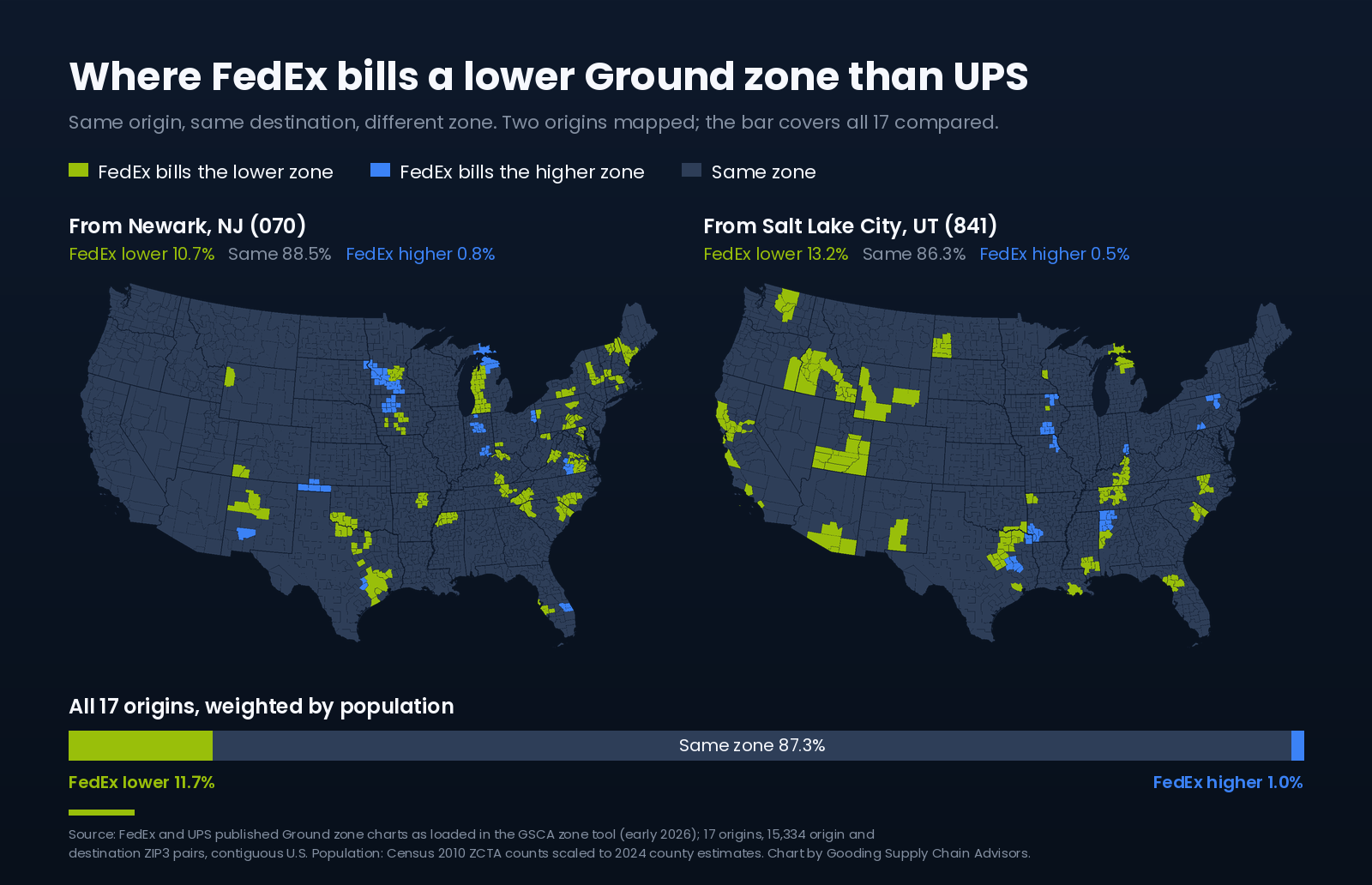
These are not fringe lanes. Houston sits a zone lower on FedEx than on UPS from 8 of the 17 origins, including Newark, Chicago and Los Angeles. From Salt Lake City, so do Los Angeles and most of the Bay Area.
The Postal Service’s zones, which are set by distance, point the same way. FedEx’s chart sits below them about seven times as often as above.
UPS has already been down this road. It reclassified zones five times between December 2023 and June 2025, and one analysis of the June 2025 round counted 1,081 changes across 75 origins, 64 percent of them to a higher zone.
So here is my working hypothesis, labeled as one: when FedEx’s reclassification takes effect, more lanes will move up than down, and most of the ones that move will be lanes where FedEx’s 2026 chart sits below UPS’s. When the new chart is out, I will run the same comparison and publish what moved, whichever way it went.
None of this makes FedEx the expensive carrier. On these lanes, its 2026 chart bills less distance than UPS’s does. That is the exposure. If you chose FedEx for a lane because it bills a zone lower than UPS, that lane is the first one to recheck after February 1.
The Third Increase: your agreement
The first two increases live in FedEx’s documents. The third lives in yours, and fall is when many agreements get signed.
An agreement that takes effect before January 4 starts on the 2026 tariff and rolls onto the 2027 tariff on January 4. Know which tariff year your pricing references, and how it moves.
Then check how your surcharge concessions are written. A fixed-dollar concession loses value every time the surcharge rises. Take the residential charge with a hypothetical $2.00 concession: your net charge goes from $4.45 to $4.90, up 10.1 percent. With a 20 percent concession instead, it goes from $5.16 to $5.52, up 7 percent. Same surcharge increase, different net increase. And concessions run on their own clocks, separate from the agreement term.
What you can still control
- Budget on your own mix, not 5.9 percent: service, weight, residential share and delivery area share.
- Reprice the surcharges you actually pay at 2027 amounts.
- Check your ZIPs against the new delivery area lists before January 4. After February 1, check your lanes, starting with the ones where FedEx billed a lower zone than UPS before the change.
- Get off paper before January 18.
- If you are signing before January 4, know which tariff year your pricing references and whether your surcharge concessions are fixed dollars or percentages.
The bottom line
FedEx held its headline at 5.9 percent for the third year running. The spread underneath it moved, the surcharge document moved, and on February 1 the zones move too.
UPS had not published its 2027 increase at the time of writing. When it does, I will run the same comparison on its tables.
Takeaway: A rate increase changes the price of a zone. A zone change changes which price you pay.
Which of the three increases is your 2027 budget built on?