An earlier piece made the case that you can ask for competitive pricing almost any time, and that moving freight is what reprices an agreement (Your Discount Held. Your Cost Did Not.). The next question is when to act on what you learn.
In my experience, a parcel bid runs four to six months from the first data pull to volume moving. Four dates you can see in advance decide where those months should fall.
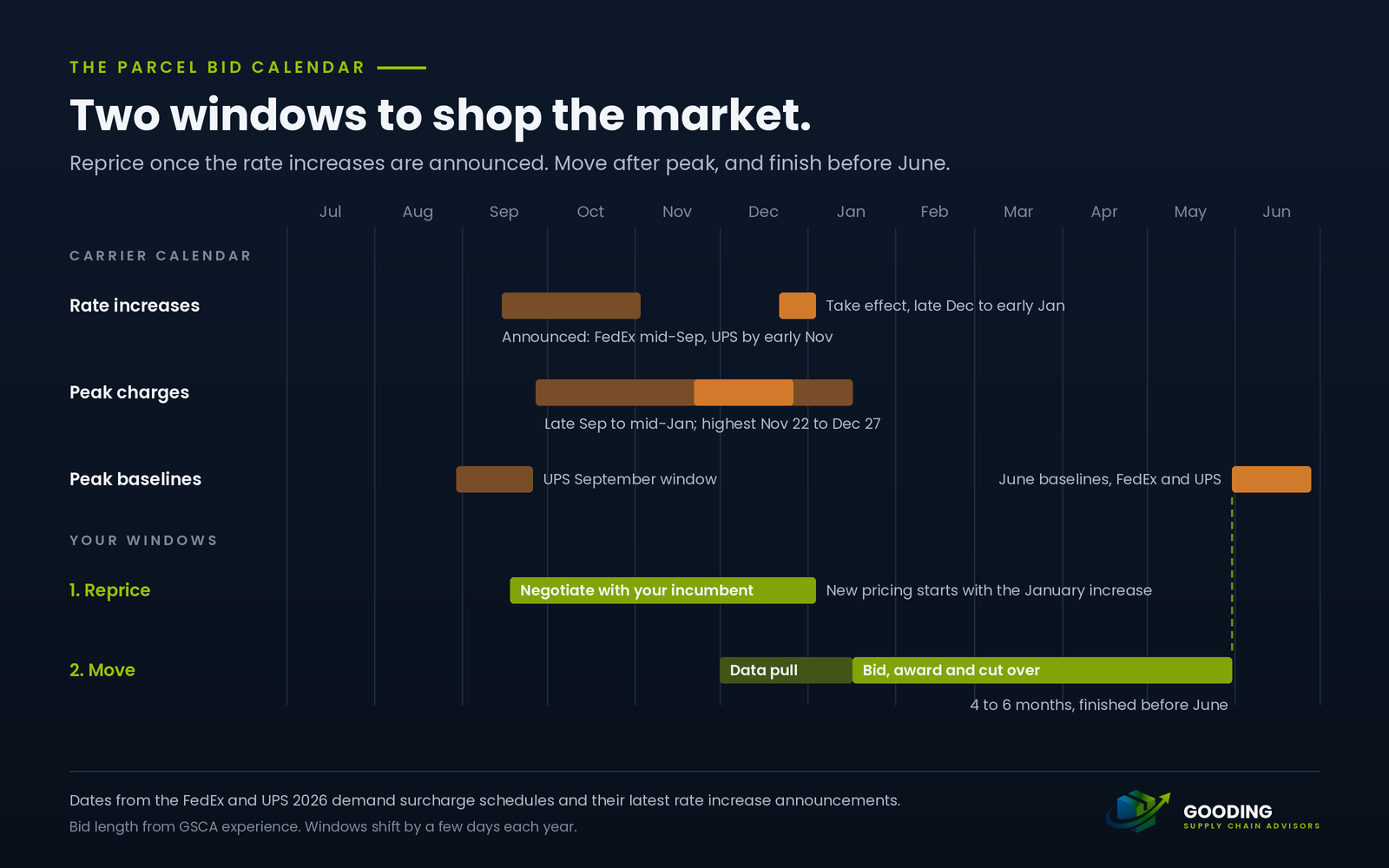
Four dates set the calendar
The general rate increase. FedEx announced its 2027 increase on September 18, 2026, effective January 4, 2027 (FedEx’s 2027 increase). UPS announced its 2026 increase by early November 2025, effective December 22.
The baseline windows. In 2025 and 2026, FedEx and UPS measured the baseline for their peak demand charges in June. In 2026 the windows ran June 1 to 28 at FedEx and May 31 to June 27 at UPS. UPS adds a second window from late August to late September, which replaces June if your volume drops below 80 percent of it (Three Windows Price Your December).
Peak. The 2026 schedules run peak charges from late September to mid-January, with the highest-priced weeks from November 22 to December 27.
Your cutover. Moving volume means new labels, new pickups and a new network. A cutover during peak puts all of that on your busiest weeks.
Those four dates leave two windows, and the goal decides which one you use.
Reprice in the fall
If the goal is a better price from the carrier you have, the window opens when the increase is announced.
- You negotiate on next year’s numbers. Once the new tariff is public, you can measure the agreement on what you’ll actually pay, and you know which tariff year your pricing references.
- The increase is a reason to reopen. A published increase moves your realized cost, which is a credible reason to ask what else can move.
- Nothing moves, so peak stays out of the way. The negotiation can run through the season, and the new pricing can start with the January increase.
Competitive proposals still belong in this window as benchmarks. Moving the freight waits for spring.
Move in the spring
If the goal is a different carrier or a different mix, volume has to move, and the cutover belongs between mid-January and the end of May: after peak closes and before the June windows open.
Finishing before June means both carriers measure your baseline on the network you’ll ship in December. Volume that arrives at a carrier after its June window wasn’t part of that June, and neither carrier’s 2026 schedule says how a baseline treats it. At UPS, volume that leaves in late summer can also trigger the September window and lower the baseline for the volume that stays.
Work backward from June 1. At four to six months, the data pull starts between December and the end of January, during or just after peak.
If the move can’t finish before June, get the winning carrier’s baseline treatment in writing before you award.
Keep June clean
The same logic applies to tests. Anything that lowers your June volume at a carrier lowers your baseline there, and the same December then prices at a higher multiple.
Take a shipper averaging 20,000 UPS packages a week in June. A four-week test that moves 2,000 a week to another carrier drops the baseline to 18,000. A 28,000-package week in December then lands at about 156 percent of baseline instead of 140. On UPS’s 2026 tiers, every package that week moves from $2.35 to $2.65, about $8,400 more for the week.
Keep tests out of June, and at UPS out of late August through late September.
These are 2026 dates. They shift by a few days each year, and the shape has held for two seasons. Check each carrier’s schedule when it publishes.
Takeaway: Pick the window by the goal: the fall to reprice, the spring to move, and June kept steady either way.
Which window does your next bid fall in?