In August I wrote that the Postal Service was the only one of the three national carriers with no automatic fuel surcharge (The Fourth Increase This Year). When fuel moved, it had to file a price change and announce it. UPS and FedEx moved a table.
On October 26, USPS published the mechanism it promised in March. Starting in January 2027, a fuel surcharge on its four domestic package products will move every week, as UPS’s and FedEx’s do.
What USPS published
The details come from a 14-question FAQ USPS posted on PostalPro.
- Products and indexes. Priority Mail Express and Priority Mail move with jet fuel. Ground Advantage and Parcel Select move with diesel. Returns for the first three are included. Domestic only, retail and commercial.
- Base. A percentage of base postage. Asked whether it also applies to extra services and nonstandard fees, USPS answered “base postage.”
- Cadence. Weekly, published 3 to 5 days ahead for diesel products and 3 to 4 days ahead for jet fuel products, through USPS’s pricing APIs, with the history posted publicly.
- Contracts. Negotiated service agreements “may have customized language.”
- Labels. Packages carrying an outdated surcharge amount are subject to postage due.
USPS hasn’t published the starting percentages, the table that turns a fuel price into a percentage, any cap or floor, or the first effective date in January.
The 8 percent “time-limited price change” USPS put on the same four products April 26 is scheduled to end January 17. In March, USPS called it “a necessary bridge to a permanent mechanism.”
The base matters more than the percentage
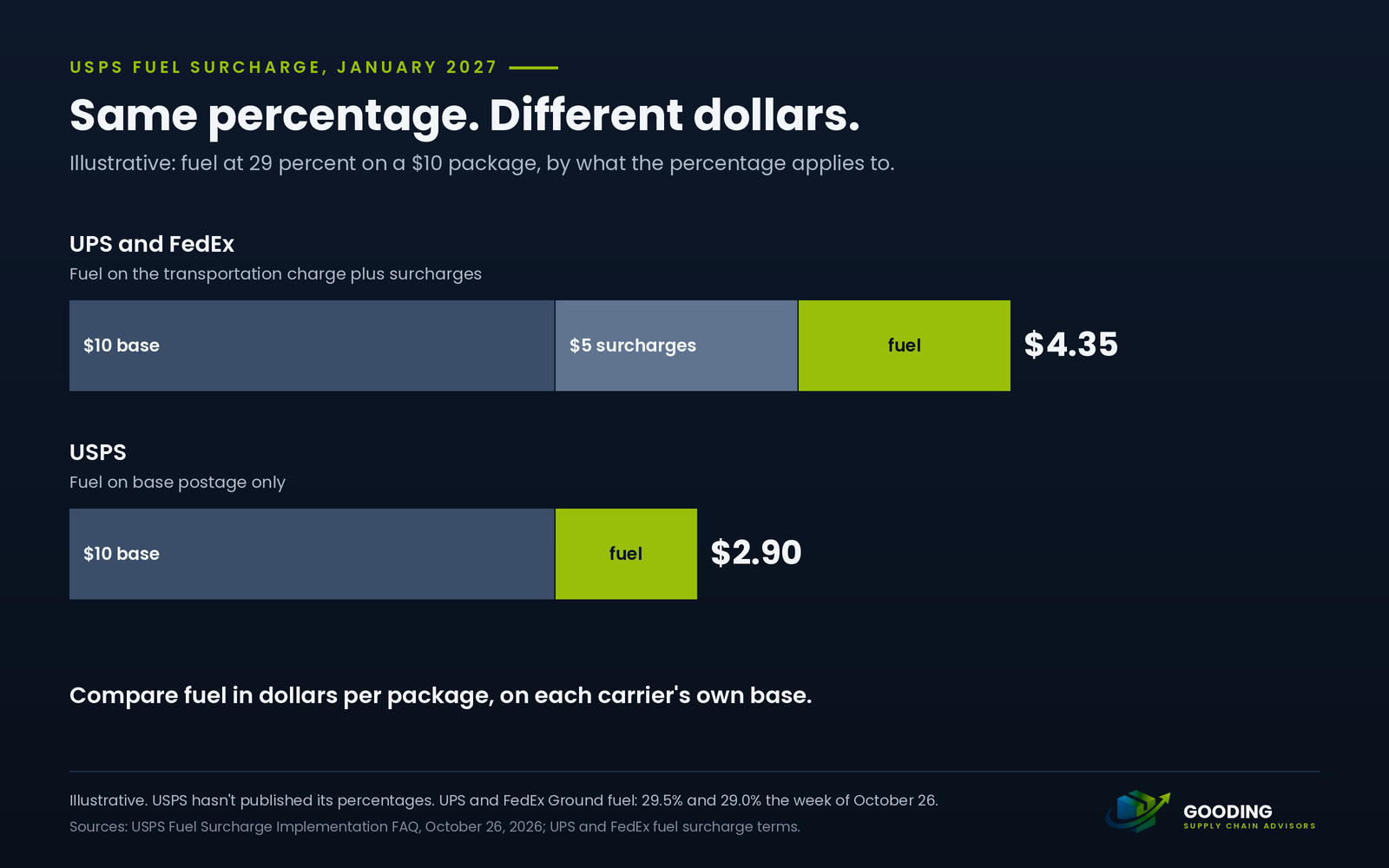
UPS and FedEx apply fuel to the transportation charge and to many of the surcharges added on top, including the residential charge. USPS will apply its percentage to base postage only, and USPS has no residential surcharge to begin with.
So the same percentage produces different dollars. An illustration at 29 percent, about where UPS and FedEx Ground sit this week:
- A $10 ground package carrying $5 of surcharges that take fuel: 29 percent of $15 is $4.35 at UPS or FedEx.
- A $10 USPS package: 29 percent of $10 is $2.90.
USPS hasn’t said where its percentage will start, so treat that as an illustration of the base, with no forecast of the rate.
For shippers: compare carriers on fuel dollars per package, figured on each carrier’s own base.
Priority Mail moves with jet fuel
Jet fuel has more than doubled in a year, while diesel is up about 73 percent. With Priority Mail on the jet index and Ground Advantage on diesel, the price gap between the two widens whenever jet runs hotter.
For shippers: check how much of your Priority Mail volume needs Priority Mail transit. Volume that can ride Ground Advantage moves to the diesel index with it.
The table sets the price
The percentage gets the attention. The table behind it decides what each fuel price costs. UPS’s domestic fuel tables change for the fifth time this year on November 2, after January 5, March 9, April 13 and August 10 (the latest change).
When USPS publishes its table, read it the way you’d read UPS’s and FedEx’s: what percentage each fuel price produces, how fast it climbs and how fast it comes back down (Diesel Is Falling. Your Fuel Surcharge Won’t.).
Fuel becomes a contract term
“May have customized language” can open fuel to negotiation for shippers with an agreement: a cap, a fixed percentage, a discount off the weekly rate or the choice of index. If your agreement says nothing about fuel, assume the published weekly rate applies.
For shippers: raise fuel with your USPS account team before January, while the table is still unpublished.
Labels printed early
A few days’ notice keeps rate shopping current. It also means a label printed before a weekly change can carry the old surcharge, and USPS says those packages are subject to postage due. Labels printed in batches or ahead of the ship date are where to look first.
January will mislead
December invoices will carry the 8 percent and the peak surcharge, both scheduled to end January 17, the month the weekly surcharge starts. A December-to-January comparison will mix at least three changes at once.
For shippers: model 2027 USPS costs from base postage, with the weekly percentage on top at several fuel prices.
The bottom line
The Postal Service ran the last fixed fuel price among the three national carriers. In January it gets a weekly one, charged on a narrower base than UPS’s or FedEx’s.
Takeaway: Compare fuel in dollars per package, on each carrier’s own base.
Does your USPS agreement say anything about fuel today?