In Part 1, I described the ratchet built into every ground fuel surcharge table: it climbs in small, fast steps when diesel rises, and gives ground in much larger, slower steps when diesel falls. Up fast, down slow, by design. Both major carriers run that same structure, so on the way down from today’s elevated diesel, every shipper is going to wait longer for relief than the run-up would suggest.
That much is shared. Here is what is not.
This spring, one of the two majors quietly reset its table. The other left its own untouched. That single difference is now the widest structural gap between the two carriers in years, and most shippers have no idea it happened.
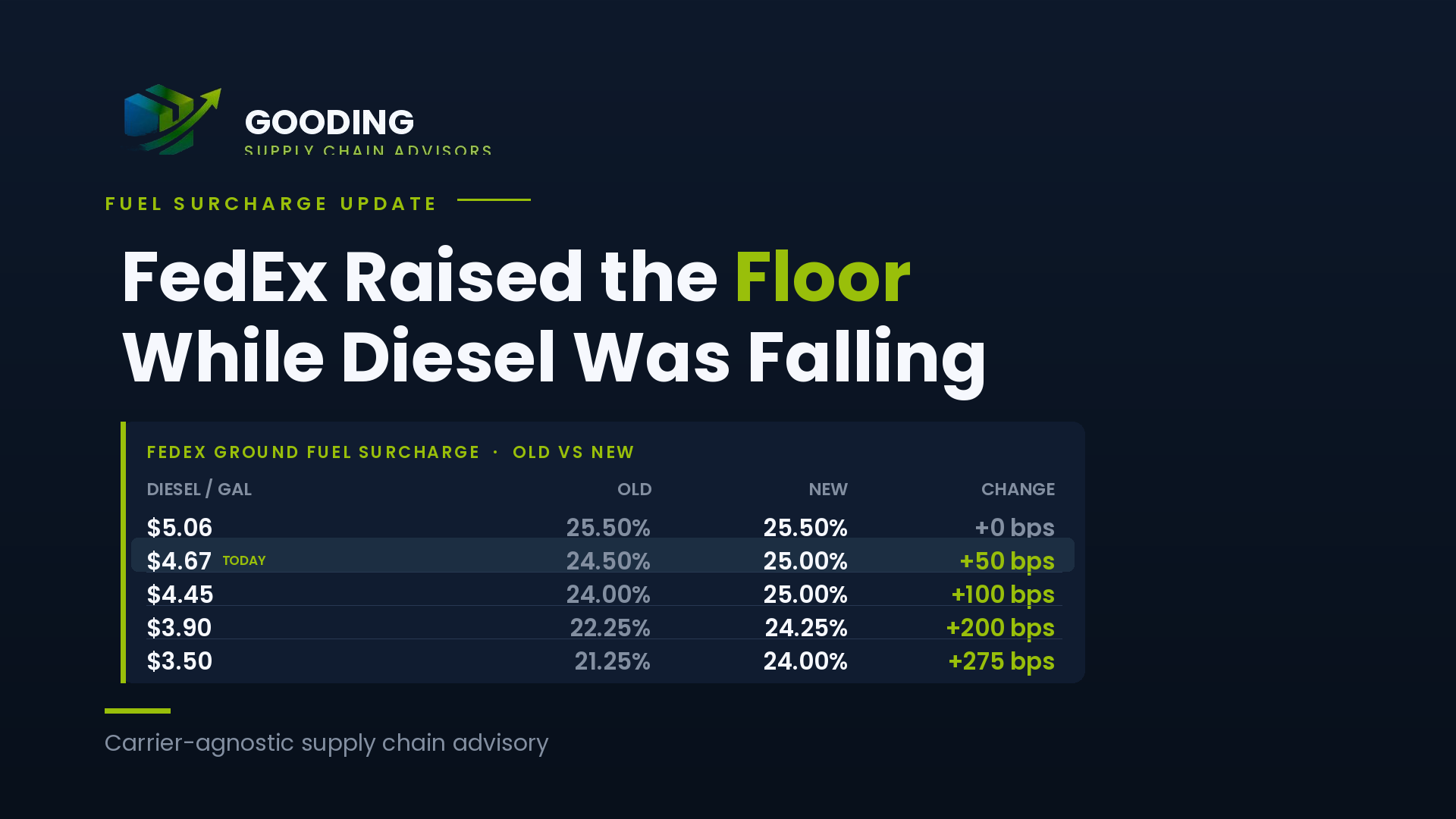
On April 13, UPS moved the pivot point of its Ground fuel surcharge from $3.55 to $4.45 a gallon. The pivot is the reference price the whole table is anchored to, so lifting it 90 cents raises the entire curve with it. FedEx has not matched the move. Its Ground pivot has sat at $3.55 since December 1, unchanged. At this week’s diesel price of $5.059, UPS publishes a Ground fuel surcharge of 26.00 percent and FedEx publishes 25.50 percent.
Fifty basis points. On its face, that looks manageable, the kind of difference a shipper might shrug at. But the gap you can see today badly understates the divergence underneath it, because the two tables are no longer built on the same foundation.
Think about what a higher pivot does. UPS’s entire surcharge curve is now referenced off a price 90 cents above FedEx’s. At any diesel price in the realistic range, UPS’s table is anchored higher, so a UPS shipper sits higher on the curve and recovers less as fuel comes down. And the gap does not hold steady as diesel falls. It widens. FedEx, anchored at $3.55, moves toward the bottom of its range sooner, while UPS, anchored at $4.45, is still calculating relief from a higher reference. The slow-relief ratchet from Part 1 then compounds the difference. The further diesel falls, the more the two structures pull apart.
You can measure how far apart by looking at where each table bottoms out. Run the diesel price down to its theoretical floor and UPS’s surcharge settles at 20.25 percent, while FedEx’s settles at 18.00 percent. That is a 225 basis point structural gap, more than four times the 50 points you see at today’s diesel. The floor is a thought experiment, not a forecast, but it is the cleanest way to see the truth: UPS has re-anchored its whole curve upward, and FedEx, for now, has not.
For now is the operative phrase. FedEx has historically followed UPS on structural changes like this one. There is no rule that says it must, but the pattern is long and consistent, and every week UPS holds its restructured table without shipper pushback is a week that makes the move easier for FedEx to copy. The question is not whether the gap closes. It is when. Which means the gap is not a permanent FedEx advantage. It is a window.
If you ship meaningful parcel volume, here is what to do with that window while it is open.
Start by auditing any UPS pricing you negotiated before April 13. The published table changed underneath those agreements without a renegotiation trigger, so the fuel economics you signed up for are not the economics you are paying today. Most shippers will not have caught it, because nothing about it arrived as a rate increase. Then model your relief on the real curve, not a straight line. Budgeting for proportional fuel relief on the assumption that a falling diesel price hands it back point for point will overstate your savings, and it will overstate them more on UPS than on FedEx. Know where each of your carriers sits relative to the other, because that 90-cent pivot gap is a quantifiable disadvantage for any shipper weighted toward UPS. And if you run both carriers or hold real leverage, treat this as the negotiating moment it is. The structural gap is sitting in the open right now, documented in two published tables. It will be harder to point to once FedEx moves.
None of this shows up in the number most shippers watch. The headline surcharge rate is the distraction. The structure underneath it, the pivot, the floor, the spacing of the steps, is the story, and right now it is telling you that your two carriers are not charging fuel the same way. The shippers who notice will use it. The rest will pay the difference and call it the cost of fuel.