Here is a peak planning point that gets overlooked: your holiday volume is a fixed number, but the days you have to move it are not.
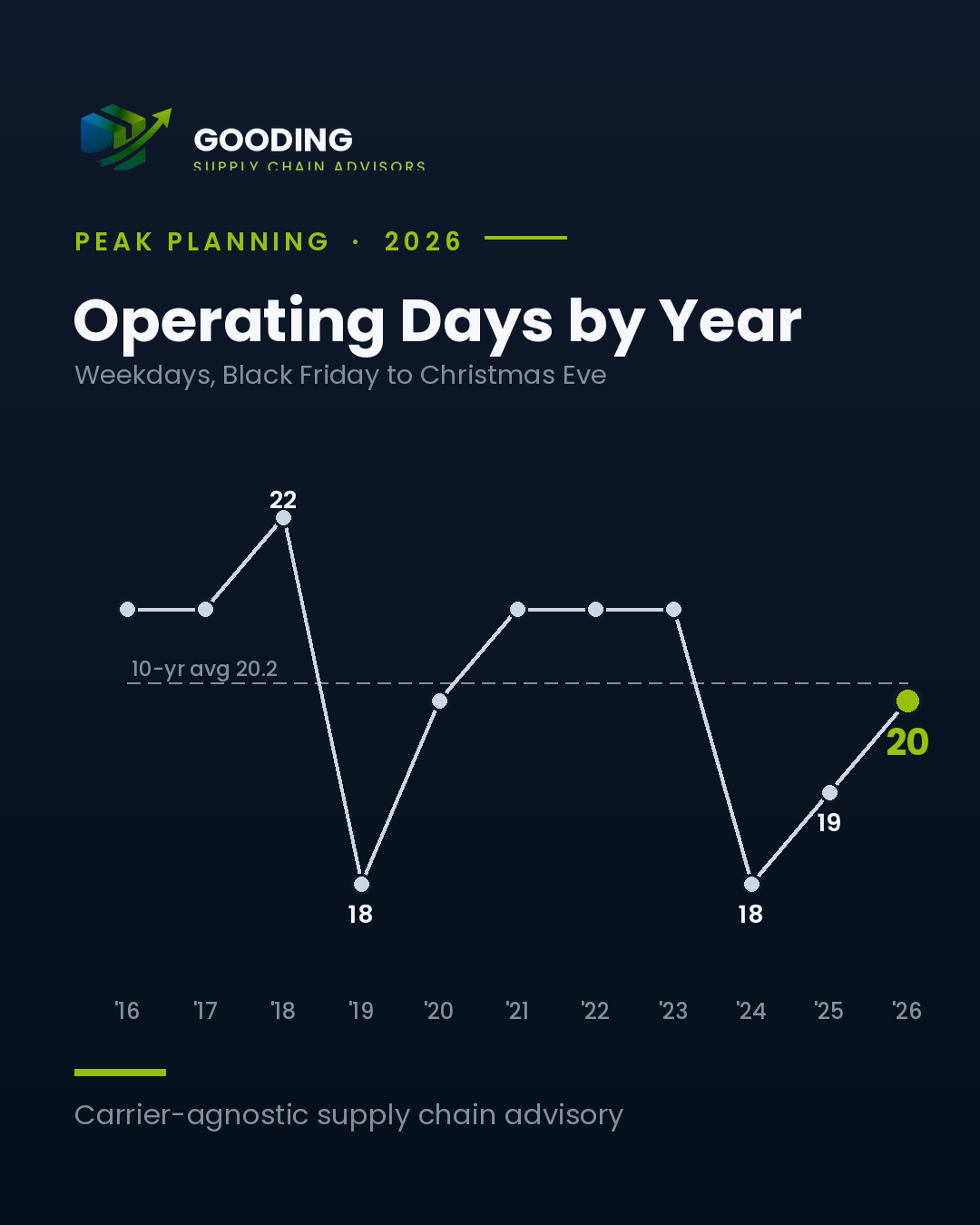
Between Black Friday and Christmas Eve, counting weekdays only, 2026 gives you 20 operating days. That matters, because the last two years didn’t. 2024 had 18. 2025 had 19. This year hands you one to two more days to work with, which is real breathing room on induction and final-mile capacity.
The lever is simple: a fixed volume spread across more days is a lower daily peak. Smoother induction, less pressure on the sort, more slack in the final mile. If you plan to it, 2026 is a friendlier calendar than either of the last two seasons.
Keep it in perspective. At 20 days, 2026 sits just below the ten-year average of 20.2, squarely mid-pack, and it’s actually the shortest of the next three years, since both 2027 and 2028 reopen to 21. So this is a rebound, not a windfall. But after two compressed seasons, one to two extra days is worth planning around.
Here’s the part that ties to the surcharge. The genuinely tight calendars are the ones where Thanksgiving lands on November 28 and the window collapses to 18 days, like 2019 and 2024. Those are the years the calendar itself forces volume into fewer days and hands carriers the cleanest justification for peak surcharge escalation. 2026 is not one of those years. The calendar is not the constraint this season.
So if the peak surcharges still climb in 2026, and they will, remember what didn’t cause it. Not a compressed calendar. The days are there. Whether you use them is an operational choice. Whether the surcharge climbs anyway is a structural one.
Plan to the 20 days. And don’t let the calendar take the blame for a surcharge it didn’t cause this year.