Ask a carrier how it feels about pricing a third-party logistics provider and you will get a careful answer. Ask again after the second drink and you will get the real one: the 3PL is a reseller. It buys transportation at one price, sells it at another, and the margin comes out of value the carrier created.
That view is unfair to the best operators in the category. It is also earned, because most 3PLs behave exactly the way it describes.
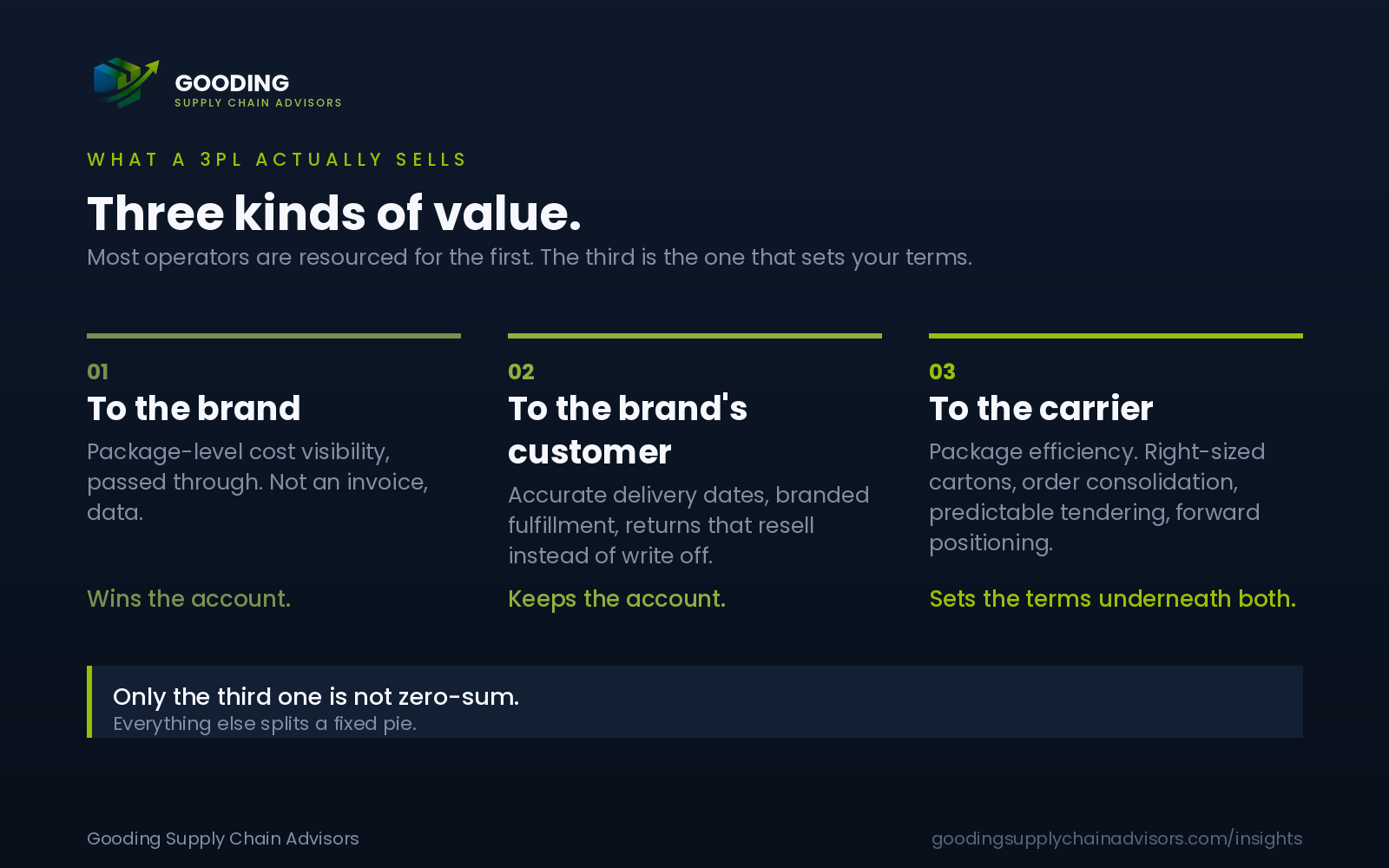
The way out is not a better negotiation. It is a different operating model, and it runs on three kinds of value: to the brand, to the brand’s customer, and to the carrier. Most 3PLs are competent at the first, uneven on the second, and have never seriously attempted the third. The third is the one that changes how a carrier prices you.
Value to the brand: stop selling rates, start selling visibility
The standard model aggregates volume, wins a competitive rate, and resells it. The margin gets applied bluntly, often as a flat uplift, and that bluntness has a consequence most operators underestimate.
A blunt margin makes package-level detail impossible to pass through. The brand gets an invoice, not data. It cannot see what a specific order cost to deliver, which means it cannot connect delivery cost to the SKU, the cart, the promotion, or the customer. It is running a direct-to-consumer business with the most variable cost line rendered as a monthly lump sum.
A best-in-class operation applies margin with enough sophistication to survive contact with the package level detail, and then passes that detail through. What the brand gets back is the ability to run cart analytics against real delivery cost, to build SKU-level marketing strategy that accounts for what each item actually costs to ship, and to see the cost of the free-shipping threshold it set two years ago and never revisited.
Two things follow that operators tend to discover only after they build it.
Invoicing moves from monthly to weekly. When cost is computed at the package rather than reconstructed at the month, there is nothing to wait for. That is a material improvement to the 3PL’s own working capital, and it is the rare operational change that the finance side asks for twice.
Rate shopping starts working correctly. This is the quiet one. If the rate-shopping engine runs against marked-up rates rather than base transportation rates, it is optimizing the wrong number and will route packages to the wrong carrier. The brand pays more than it should, the 3PL looks arbitrary, and the carrier sees volume behaving in ways its own pricing logic cannot explain. Everyone loses, and the cause is invisible from every seat.
The broader point is one I have made to brands repeatedly: a discount is not a cost, and neither is a rate. What the invoice actually produced is the only number that matters. A 3PL that can show its brands that number is selling something no rate card can match.
Value to the customer: the part the brand cannot outsource its reputation for
The consumer does not know the 3PL exists. They know whether the box arrived when the site said it would, whether it looked like the brand, and whether sending it back was easy.
That makes the fulfillment operation the brand’s reputation, executed by someone else, which is a heavier responsibility than a rate card implies.
The baseline is accurate estimated delivery dates and clean advance ship notices. Not optimistic dates. Accurate ones, because the gap between the promise at checkout and the arrival is where trust is lost, and the research on cart abandonment when delivery expectations are unclear is not ambiguous.
Above the baseline is where a 3PL stops being interchangeable. Branded and bespoke kitting. Where the category calls for it, custom screening, embroidery, and alterations, executed inside the fulfillment flow rather than as a separate vendor and a separate delay. These are the capabilities a brand cannot easily move, which is a more durable form of retention than price.
And returns, which most operations still treat as a cost center to be minimized. Two customers exist in a return. The consumer, who needs it to be effortless. And the brand, which needs the item assessed, routed, and resold rather than written off. A 3PL that manages the second half well is protecting margin the brand had already given up on.
Value to the carrier: the one nobody works on
Here is the pillar that separates the category, and almost nobody is doing anything about it.
Most 3PL and carrier conversations are zero-sum. The 3PL wants a lower rate. The carrier wants a higher one. Both sides negotiate over the split of a fixed pie, and the carrier concludes, reasonably, that the relationship has no dimension beyond price.
Package efficiency is the exception. It is the one thing a 3PL can do that makes the carrier’s economics better and the brand’s cost lower at the same time. It is not a concession traded for a concession. It is a larger pie.
Four levers, all of them within a fulfillment operator’s control:
Right-sized cartons. Dimensional weight is charged on cube, so an oversized box costs the brand money and costs the carrier capacity on a vehicle that prices by space. Fixing it pays both sides. Very few relationships have anything else with that property.
Order consolidation. Two packages to one address on the same day is two stops’ worth of cost for one delivery’s worth of revenue. Combining them removes a package from the network and a line from the invoice.
Aggregated, predictable volume. Not just volume. Volume the carrier can plan around, tendered consistently, without the spikes that force capacity to be held in reserve.
Forward positioning. Product closer to the consumer means shorter zones, which is cheaper for the brand and less linehaul for the carrier. The last-mile math problem does not get solved by density alone, and moving inventory closer is one of the few levers that changes the inputs rather than the outputs.
A 3PL doing these four things is no longer asking a carrier for a better price on the same packages. It is handing over a better book of business. That is the conversation where the carrier’s tone changes.
And then there is peak
This is where the reseller framing costs 3PLs the most money, and it is the clearest argument for building the carrier relationship before you need it.
Peak and demand surcharges at the national carriers are tiered. The tiers key off volume, and the assessment is made at the account level.
A 3PL serving a large number of small and mid-sized brands aggregates all of that volume into one account. That aggregation is the entire value proposition on the rate side. It is also what places the 3PL in a surcharge tier that its individual clients, shipping on their own, would in many cases never reach.
Read that twice, because it is the uncomfortable shape of it. The mechanism that earns the 3PL its rate advantage can simultaneously expose it to a peak cost that the brands it serves would not individually face. Whatever the intent behind the tier design, that is the effect on an operator whose book is built from SMBs.
You cannot negotiate your way out of that with a rate argument, because the tier is not a rate. But it is a conversation, and which conversation you get depends entirely on whether the carrier sees a reseller or a partner. A partner who has spent the year improving dimensions, consolidating orders, and tendering predictable volume is in a materially different position when peak terms come up than one who shows up in August asking for relief.
That work is done in February. Not in August, and certainly not in October.
The three compound
Value to the brand earns the account. Value to the customer keeps it, because it builds capability the brand cannot easily move. Value to the carrier is what determines the terms underneath both, and it is the one that takes longest to build and matters most when it counts.
Most operators in this category are running on the first pillar and calling it a strategy. It is a rate. Rates get matched.
Takeaway: A 3PL that only aggregates volume is a reseller with a warehouse. The ones that will still be here in five years are building something the carrier wants too.
Which of the three are you actually resourced for, and when did a carrier last tell you that you had made their network better?